Boys and young men of color (BYMOC) face numerous challenges across their life courses. From increased rates of childhood poverty to disproportionate police contact and high unemployment, the barriers BYMOC must navigate on the pathway to success are typically not experienced by their white peers. These challenges are pervasive, affecting BYMOC regardless of socioeconomic status, and many of them are intricately and inextricably linked. For instance, early reading difficulties may result in placement in special education courses which are associated with much higher rates of high school dropout which are associated with lower lifetime earnings, poorer health, and greater reliance on public benefits. At each stage in this experience, challenges may be compounded by daily interactions that include overt discrimination, microaggressions, or systemic oppression (e.g., disproportionate police contact).
Adolescence and emerging adulthood is a time when individuals integrate their lived social, cultural, interpersonal, and emotional experiences into their own identities. This process, taken together, is often called youth development. It reflects the ongoing establishment of one’s knowledge, attitudes, skills, and behaviors that will ultimately comprise one’s personality or identity in adulthood. The influence of these social, cultural, interpersonal, and emotional experiences on a person’s development is best captured in the Social Ecological Theory. The theory holds that individuals encounter a range of factors within spheres of influence around the individual—some more closely connected to the individual than others—that influence their development over time. These spheres are usually classified as (from proximal to distal): Individual, Interpersonal, Community, and Societal.
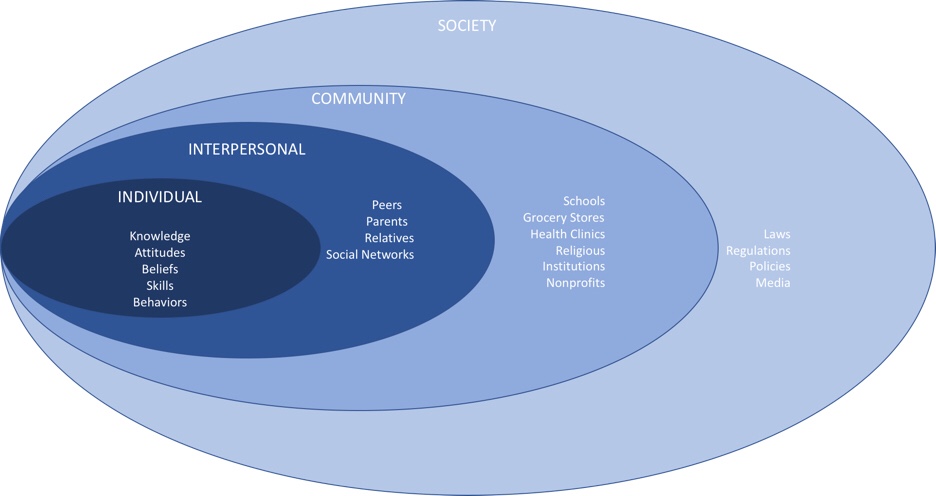
This model best captures the interrelatedness of factors that contribute to youth’s development and provides insight into the breadth of issues facing BYMOC. The obstinacy and complexity of these issues have led advocates, policy makers, academics, and communities to seek broad scale, collaborative solutions. These solutions are intended to produce holistic approaches that address challenges from multiple perspectives (e.g., addressing housing and hunger issues to improve early literacy).
Indeed, we have seen such approaches meet with notable success in recent years. StriveTogether, Promise Neighborhoods, and America’s Promise Alliance, just to name a few, have all made remarkable strides toward achieving holistic pathways of opportunity for marginalized children and families. These approaches and others are certainly worth continued examination, adaptation, and replication where appropriate. Despite these recent victories, BYMOC nationally continue to lag behind their peers in achieving important milestones on the road to success (e.g., 3rd and 8th grade literacy, high school credit completion, high school graduation, employment, civic engagement). What these successes indicate, though, is that BYMOC, provided appropriate (i.e., equitable) opportunities, can and will thrive across a range of life domains.
We are particularly interested in the potential represented in the Interpersonal and Individual levels of the social ecological model. Positive influences focused in these areas can have profound implications at the Community and Societal levels. This is particularly true for marginalized groups, such as young men of color, for whom personal development and accumulation of social capital accelerates and sustains positive changes at the Community and Societal levels.
Mentoring is one of the most prominent and promising interpersonal level interventions reflected in the approaches mentioned above and many others. Decades of research support the positive effects that quality mentoring can have on children and youth, including BYMOC. The appeal of mentoring is, at least in part, associated with its ability to operate “holistically,” providing support to young people across life domains as needed. Perhaps unsurprisingly, mentoring has been featured and promoted heavily as part of President Obama’s My Brother’s Keeper Alliance (MBKA) and other national campaigns to improve the prospects of BYMOC.
Another theory, Social Cognitive Theory, forms the theoretical underpinning of many mentoring programs. The theory holds that in the process of development youth rely upon models with whom they can relate, either directly or vicariously. The extent to which the individual “wishfully identifies” with the model greatly influences the extent to which the individual will imitate the model’s attitudes, beliefs, and behaviors. In this way, mentors’ position as positive role models is potent, particularly in the context of many young men of color who experience “male model vacuums” due to various social and cultural realities (e.g., mass incarceration, unemployment, paternal absence).
In 2016, seeking to tailor mentoring to the specific needs and experiences of BYMOC, MENTOR: The National Mentoring Partnership, in partnership with MBKA, produced a companion guide to its 4th edition of “Elements of Effective Practice for Mentors.” The companion guide, titled “Guide to Mentoring Boys and Young Men of Color,” recommended a strengths-based approach called “critical mentoring” that emphasizes “cultural humility” on the part of mentors and development of critical consciousness within mentors and mentees alike. The basic premise of the approach is that BYMOC feel the strengths inherent in their experiences and cultures are respected, validated, and valued when those strengths are acknowledged and leveraged in the course of a mentoring partnership. This results in a stronger youth-adult relationship than a deficit-based approach. The youth is more likely to “wishfully identify” with the adult. Critical consciousness has been defined briefly as the “capacity to recognize and overcome sociopolitical barriers.” The pursuit of critical consciousness within supportive relationships helps to awaken and prepare BYMOC to navigate and address systemic barriers to their success. Given its popularity, cultural relevance, history of challenging the sociopolitical status quo, and rich themes related to adolescence and emerging adulthood, we believe that hip hop music can be a powerful facilitator of critical consciousness and much more.
In the absence of positive models–whether through formal mentoring relationships or informal caring relationships–many young men of color fill the “male model vacuum” with near-age peers (direct) and/or media portrayals (vicarious). With regard to the vicarious models offered through media portrayals, hip hop music provides unparalleled access to young men of color. According to Nielsen, R&B/Hip Hop became the most popular music genre for the first time in 2017, and young people are accessing music through live streaming via smartphones more than ever. While this may be cause for concern among some who view hip hop as a negative influence on young people, particularly BYMOC, we see it as a great opportunity to seize on culturally relevant teachable moments.
True, the strong appeal of hip hop music to youth, especially young men of color, can contribute to modeling and identity formation based on overt notions of masculinity, manhood, success, and other themes that may actually impede positive development and undermine well-being. Certainly, other forms of media convey similar messages, though perhaps with less scrutiny and consternation (e.g., action movies, pornography, rock music). Moreover, we regularly witness manifestations of these notions in the forms of machismo, misogyny, and misanthropy in the halls of power of “mainstream” society. In any case, we must not castigate the whole of hip hop for its potential contribution to maladaptive youth development without recognizing its equal or greater potential for promoting positive outcomes.
Much of the hip hop universe is filled with overt and more subtle themes that can contribute to cultural humility, critical consciousness, and a host of other developmental assets for young men of color. The major mitigating factor in determining how an audience, especially youth, receives and responds to media messages is interpretation. Message Interpretation Processing theory suggests that youth assess media messages along three dimensions: realism (how realistic does it seem); similarity (how similar is it to one’s own experiences); and desirability (how desirable is the experience portrayed). Further, the theory holds that “if the logical responses to media messages are strengthened by teaching and practicing media deconstruction skills, then these cognitions may negate the positive emotional influence of the message on decision making about risky health behaviors.” What this means in practice is that if youth have caring adults to help them navigate and “deconstruct” the messages presented in hip hop, they can actually build resilience against potentially harmful interpretations. Perhaps more importantly, in keeping with a strengths-based approach, we suggest that these adult navigators can help youth identify positive messages in hip hop music and use them to bolster their developmental assets.
Hip Hop IllumiNation harnesses the powerful and positive messages of hip hop music to promote critical consciousness and positive youth development. It complements and extends the work of MENTOR, MBKA, and others by providing a compendium of easily-accessible structured lessons for use by mentors, parents, teachers, and other caring adults. The lessons are designed to reach young men of color with culturally relevant themes and exercises that promote critical consciousness and a host of other essential protective factors. They use lyrics and themes from hip hop songs to generate reflection, discussion, and action aligned with domains of critical consciousness (e.g., social, economic) and youth development (e.g., confidence, character, caring).
Young men of color face incredible odds in many domains of life. Yet, we know that they are eager to thrive because, when given the opportunity, they do. Our hope is that Hip Hop IllumiNation helps you shed light on possibilities for young men that let them shine.
 Hip Hop IllumiNation